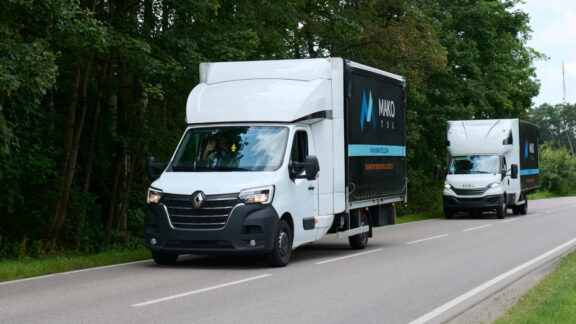
Tachographs did not stop our fleet.
Since 1 July 2026, the tachograph requirement also applies to Sprinter vans and other light commercial vehicles with a maximum authorised mass of more than 2.5 tonnes and up to and including 3.5 tonnes. A trailer or semi-trailer is included when calculating this mass. The rules apply to cross-border goods transport and cabotage operations. Vehicles used exclusively for domestic transport are not covered.
The new regulations required a reorganisation of daily operations. At the same time, the number of available vehicles fell, making transport planning more difficult for many customers. This makes stable partners that are prepared for the new conditions and can continue to provide reliable transport capacity all the more important.
At MAKO TSL, we started preparations early and adapted our fleet and planning processes to the new requirements. As a result, even under the changed conditions, we can continue to provide our customers with the transport capacity they need and carry out their transport reliably and in compliance with the applicable regulations.
What is a digital tachograph and which light commercial vehicles are subject to the tachograph requirement?
Tachographs were long associated primarily with heavy trucks. Since July 2026, however, the requirement also applies to many vans, Sprinter vans, panel vans and other light commercial vehicles used for international road transport of goods.
A digital tachograph, also referred to as recording equipment, records the driver’s driving times, breaks and rest periods. The device also records other working hours, distance travelled, speed and border crossings.
A second-generation smart tachograph, known as Smart Tacho 2 or G2V2, is mandatory. The data recorded must be read out and archived regularly.
Under the 2026 tachograph requirement, the affected drivers are subject to mandatory driving and rest time rules. This changes the planning of international transport. In addition to distance, traffic and the delivery deadline, the driver’s available driving time and necessary breaks must be taken into account.
What risks did the transport market anticipate?
Before the tachograph requirement was extended to vans, uncertainty in the industry was high. The affected vans had to be retrofitted, drivers trained and existing processes adapted.
Warnings focused particularly on a declining number of available vans, longer transit times on international routes and higher prices for express and direct transport.
Mandatory breaks and rest periods limit the distance a driver can cover in a day. A lack of preparation can therefore lead to vehicle downtime, delayed departures and lower vehicle utilisation.
For customers, this raised an important question: can time-critical transport still be planned reliably?
Monthly fleet mileage remained stable
At MAKO TSL, average monthly fleet mileage remained almost unchanged.
Our customers continue to have access to high transport capacity and can count on scheduled loading and unloading as well as reliable handling of international transport. By quickly selecting a suitable vehicle, we reduce the risk of avoidable delays. Legal requirements are taken into account at the planning stage.
Our preparations have shown that new legal requirements do not automatically have to bring operations to a standstill. The key is to integrate them early into processes, fleet planning and drivers’ daily work.
How did MAKO TSL prepare for the tachograph requirement?
At MAKO TSL, we knew well in advance that the new regulations would require careful preparation. That is why we prepared the affected fleet of vans, our processes and our technological solutions for the 2026 tachograph requirement at an early stage.
Today, nearly 1,000 vehicles are available to our customers. Our modern AI-supported TMS allows us to assign the right vehicle to each transport order in real time and use the entire fleet efficiently.
During planning, we take into account the vehicle’s current location, the driver’s remaining driving time, required breaks and rest periods, and the planned loading and unloading times. We also check the distance to the pickup location and the availability of suitable alternative vehicles.
Particular attention is paid to the precise planning of weekly rest periods, the start and end of breaks, avoiding unnecessary vehicle movements, and organising departures after the weekend.
This allows our team to select at an early stage the vehicle that can complete an order within the required time and in compliance with the new regulations, while reliably planning the scheduled loading and unloading times.
Smart Tachograph 2 as a tool for better fleet planning
Long term, we see tachographs as a tool for even more precise planning. Available tachograph and vehicle data help us improve efficiency, gain greater control over the transport process and further optimise use of our fleet.
At MAKO TSL, we do not leave changes of this scale to chance. We prepare our fleet, systems and teams early so that we can continue to carry out our customers’ transport reliably even under new market conditions.
Planning a time-critical transport?
Need express or direct transport within Europe? Our team selects the right vehicle for your order, takes statutory driving and rest times into account at the planning stage, and manages the transport through to delivery.
Contact MAKO TSL for a transport solution individually tailored to your shipment.